
When Compressors Lie
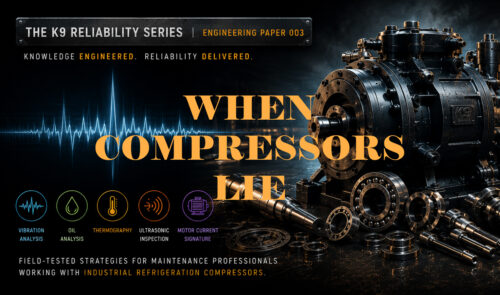
Why Normal Operating Conditions Can Hide Serious Internal Problems
By Dr L. Wang
Diagnostics & Condition Monitoring
BEFORE YOU BEGIN READING
One of the most dangerous assumptions in industrial refrigeration is that "everything looks normal."
The compressor starts on time.
Oil pressure remains within specification.
Discharge temperatures appear acceptable.
No unusual vibration is noticed during routine inspections.
Production continues uninterrupted.
From every visible indicator, the machine appears healthy.
Yet experienced reliability engineers know that catastrophic failures rarely begin with obvious warning signs.
More often, they begin beneath the surface—inside bearings that are slowly deteriorating, lubrication systems that are quietly becoming contaminated, valve assemblies beginning to fatigue, or alignment conditions gradually drifting away from design specifications.
These early changes rarely stop production.
Instead, they become invisible companions to normal operation.
By the time traditional operating parameters finally indicate that something is wrong, the internal damage has often progressed far beyond the point where a simple maintenance intervention would have been sufficient.
This Engineering Paper explores one of the most misunderstood realities of compressor reliability:
Machines can appear perfectly healthy while silently progressing toward failure.
Understanding why this happens is one of the most valuable skills any maintenance engineer can develop.
FROM DR. L. WANG'S DESK
"Throughout my career, I have investigated compressor failures on five continents.
Although every investigation begins with a different machine, industry, or operating environment, one statement appears with astonishing consistency.
"Everything looked normal."
Those words have accompanied seized bearings, fractured crankshafts, damaged rotors, collapsed valve assemblies and catastrophic lubrication failures.
The operators were not careless.
The maintenance teams were not inexperienced.
The instrumentation wasn't necessarily inaccurate.
The problem was much simpler.
They were observing the wrong evidence.
Compressors rarely conceal failure.
Instead, they reveal it through signals that traditional operating parameters cannot always detect.
Those signals may appear inside vibration spectra, oil analysis reports, ultrasonic measurements, and motor current signatures.
Or hidden within microscopic wear particles long before temperatures or pressures begin changing.
The purpose of this Engineering Paper is not to encourage unnecessary maintenance.
It is to encourage better observation.
Because machines don't usually fail without warning.
We simply don't always recognize the language they're using."
CHAPTER ONE
The Dangerous Comfort of Normal
Walk through almost any industrial refrigeration plant, and you'll hear a familiar phrase.
"The compressor seems fine."
It's a reassuring statement.
Unfortunately, it is not a diagnostic conclusion.
It is an observation.
There is a significant difference.
Human beings naturally judge machine condition using the senses available to them.
We listen.
We look.
We feel vibration by placing a hand on the machine.
We observe pressure gauges.
We monitor discharge temperatures.
These observations remain valuable.
But they represent only a small fraction of the information a compressor continuously generates.
Imagine visiting a hospital where every patient receives the same medical examination.
A doctor checks body temperature.
Measures blood pressure.
Listens briefly to the heartbeat.
Then declares every patient healthy without conducting blood tests, imaging studies or laboratory analysis.
Most people would immediately recognize the limitations of such an approach.
Yet many industrial compressors are evaluated in exactly this manner.
If the gauges appear normal...
If no abnormal noise is heard...
If production continues...
The machine is assumed to be healthy.
Reliability engineering demands a higher standard.
The absence of visible symptoms should never be mistaken for the absence of developing faults.
Because the earliest stages of mechanical deterioration often occur long before traditional operating parameters begin changing.
That is precisely why catastrophic failures appear so unexpected.
The evidence existed.
It simply wasn't being observed.
Wangs's Field Note
"Machines rarely surprise us. They simply reveal their evidence earlier than we choose to investigate."