

Vibration Analysis
September 20, 2026
Why Normal Operating Conditions Can Hide Serious Internal Problems
By Dr L. Wang
Diagnostics & Condition Monitoring
FROM THE AUTHOR’S DESK
"Throughout my career, I have investigated compressor failures in almost all continents.
Although every investigation begins with a different machine, industry,
or operating environment, one statement appears with astonishing consistency.
"Everything looked normal."
Those words have accompanied seized bearings, fractured crankshafts,
damaged rotors, collapsed valve assemblies and catastrophic lubrication failures.
The operators were not careless.
The maintenance teams were not inexperienced.
The instrumentation wasn't necessarily inaccurate.
The problem was much simpler.
They were observing the wrong evidence.
Compressors rarely conceal failure.
Instead, they reveal it through signals that traditional operating parameters cannot always detect.
Those signals may appear inside vibration spectra, oil analysis reports, ultrasonic measurements,
and motor current signatures.
Or hidden within microscopic wear particles long before temperatures or pressures begin changing.
The purpose of this Engineering Paper is not to encourage unnecessary maintenance.
It is to encourage better observation.
Because machines don't usually fail without warning.
We simply don't always recognize the language they're using."
The Dangerous Comfort of Normal
Walk through almost any industrial refrigeration plant, and you'll hear a familiar phrase.
"The compressor seems fine."
It's a reassuring statement.
Unfortunately, it is not a diagnostic conclusion.
It is an observation.
There is a significant difference.
Human beings naturally judge machine condition using the senses available to them.
We listen.
We look.
We feel vibration by placing a hand on the machine.
We observe pressure gauges.
We monitor discharge temperatures.
These observations remain valuable.
But they represent only a small fraction of the information a compressor continuously generates.
Imagine visiting a hospital where every patient receives the same medical examination.
A doctor checks body temperature.
Measures blood pressure.
Listens briefly to the heartbeat.
Then declares every patient healthy without conducting blood tests, imaging studies or laboratory analysis.
Most people would immediately recognise the limitations of such an approach.
Yet many industrial compressors are evaluated in exactly this manner.
If the gauges appear normal...
If no abnormal noise is heard...
If production continues...
The machine is assumed to be healthy.
Reliability engineering demands a higher standard.
The absence of visible symptoms should never be mistaken for the absence of developing faults.
Because the earliest stages of mechanical deterioration often occur long before traditional operating parameters begin changing.
That is precisely why catastrophic failures appear so unexpected.
The evidence existed.
It simply wasn't being observed.
Wangs's Field Note
"Machines rarely surprise us. They simply reveal their evidence earlier than we choose to investigate."
The Difference between Operating Data and Diagnostic Data
One of the greatest misconceptions in industrial maintenance is the belief that operating data and diagnostic data are interchangeable.
They are not.
Operating data answers one question:
"Is the compressor currently performing its intended function?"
Diagnostic data answers an entirely different question:
"What condition is the compressor in while performing that function?"
A compressor can continue delivering refrigeration capacity while internal wear accelerates.
It can maintain acceptable discharge temperatures while bearing surfaces begin deteriorating.
It can sustain normal oil pressure despite increasing contamination.
Operating performance and mechanical condition often travel together.
But they do not always do so at the same speed.
This distinction forms the foundation of predictive maintenance.
Traditional monitoring tells engineers how the machine is performing today.
Condition monitoring reveals how the machine is likely to perform tomorrow.
Understanding that difference changes maintenance philosophy completely.
Maintenance is no longer scheduled after symptoms become obvious.
It becomes planned while the intervention is still simple, economical and controlled.
That is where modern reliability engineering begins.
Wangs's Reflection
"Performance tells us what a machine is doing. Diagnostics tells us what the machine is becoming."
Silent Failures: When the Evidence Exists but Nobody Looks
Mechanical failures are often described as sudden.
In reality, very few compressor failures are genuinely sudden.
Most are simply undetected.
The distinction is critical.
A connecting rod does not fracture without experiencing fatigue.
A bearing does not seize without lubrication gradually deteriorating.
A discharge valve does not fail without microscopic damage accumulating over thousands of operating cycles.
These processes begin quietly.
Long before production notices.
Long before alarms activate.
Long before temperatures exceed acceptable limits.
The compressor continues operating.
Operators become comfortable.
Maintenance schedules remain unchanged.
The machine develops a reputation for being "reliable."
Unfortunately, reliability based only on uninterrupted operation can become dangerously misleading.
A compressor may continue producing refrigeration while internal degradation accelerates every hour.
This period—between the beginning of deterioration and the appearance of visible symptoms—is often referred to as the hidden failure interval.
For reliability engineers, this interval represents the greatest opportunity to prevent catastrophic failure.
It is also the period most frequently ignored.
Because nothing appears urgent.
There is no emergency.
No production loss.
No immediate pressure to act.
Yet this quiet interval is precisely where the greatest value of condition monitoring exists.
Finding evidence before failure becomes visible.
Wangs's Field Note
"Machines don't fail overnight. They simply spend weeks or months waiting for someone to notice."
Diagnostic Windows Every Reliability Engineer Should Use
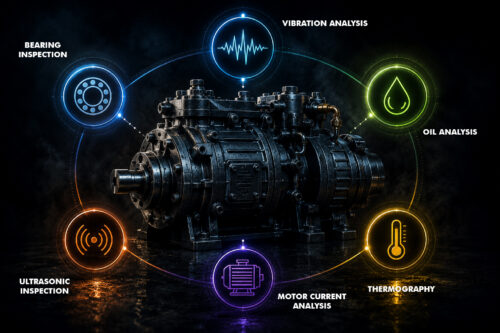
Industrial compressors continuously generate information.
The challenge is knowing where to look.
Over many years of field investigations, I have found that nearly every significant compressor failure leaves evidence in one or more of the diagnostic windows.
Understanding these windows transforms maintenance from reactive repair into informed decision-making.
Vibration Analysis
Vibration remains one of the earliest indicators of developing mechanical faults.
Changes in vibration frequency or amplitude often reveal bearing wear, shaft imbalance, coupling misalignment, looseness or valve abnormalities long before operators hear unusual noise.
The objective is not merely to measure vibration.
It is to understand what each vibration signature represents.
A compressor always vibrates.
The question is whether it vibrates normally.
Oil Analysis
Lubricating oil functions as far more than a lubricant.
It is a diagnostic sample continuously circulating through the machine.
Every oil analysis report tells a story.
Microscopic iron particles.
Copper.
Aluminium.
Silicon contamination.
Water ingress.
Oxidation.
Viscosity changes.
These findings frequently reveal developing problems months before mechanical symptoms become apparent.
Ignoring oil analysis is equivalent to ignoring a blood test that already indicates illness.
Thermography
Temperature rarely causes failures.
Instead...
Temperature reflects them.
Thermal imaging allows engineers to identify abnormal heat patterns associated with overloaded bearings, electrical connections, lubrication deficiencies and cooling inefficiencies.
Temperature trends often reveal deterioration more effectively than single temperature readings.
Context matters.
Trend matters.
Comparison matters.
Motor Current Signature Analysis
Electric motors communicate mechanically as well as electrically.
Changes in current signatures may indicate rotor defects, mechanical loading changes or developing compressor problems.
Although frequently overlooked within refrigeration plants, motor current analysis provides another valuable layer of diagnostic confidence.
Ultrasonic Inspection
Many lubrication failures begin long before they become audible.
Ultrasonic instruments detect high-frequency sound generated by friction, leakage and early mechanical distress.
To the human ear, everything sounds perfectly normal.
To ultrasonic equipment...
The warning has already begun.
Bearing Inspection
Bearings are among the earliest components to reveal signs of developing mechanical distress.
Making bearing analysis a cornerstone of effective condition monitoring.
Subtle increases in vibration frequencies, rising operating temperatures, changes in lubrication condition, or the presence of microscopic wear particles in oil samples often indicate bearing deterioration long before audible noise or catastrophic failure occurs.
By monitoring these indicators and analysing long-term trends rather than isolated readings, maintenance teams can identify emerging defects, schedule planned interventions, and prevent secondary damage to shafts, housings, and other critical compressor components.
In reliability engineering, bearing analysis is not merely about detecting wear—it is about understanding the health of the entire rotating assembly before production is ever affected.
Wangs's Reflection
"One diagnostic tool may suggest a problem. Two tools confirm suspicion. Three independent indicators create confidence."