Compressor Lifecycle Maintenance Guide
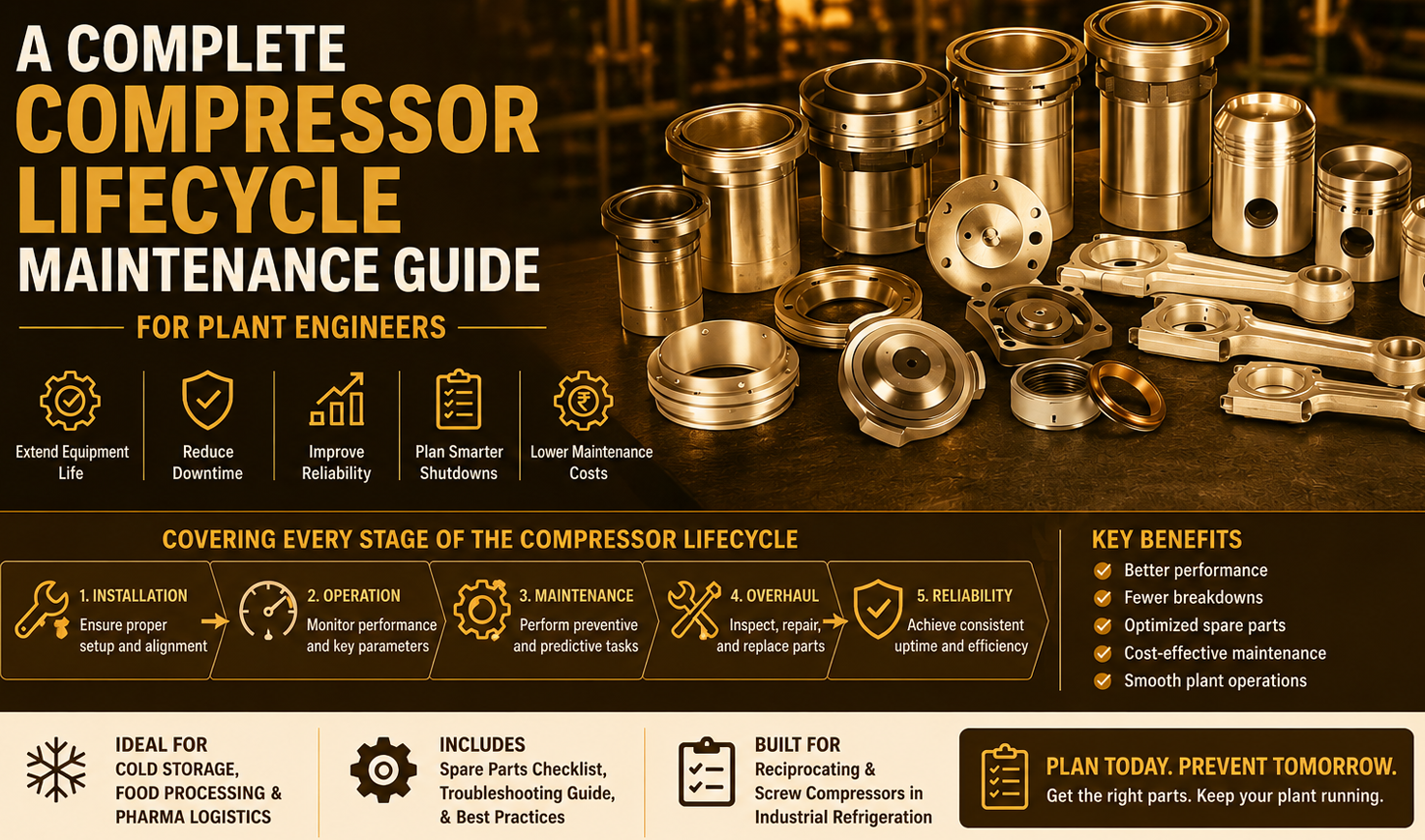
A Complete Compressor Lifecycle Maintenance Guide for Plant Engineers
Introduction
Maintenance shutdowns often feel stressful. Teams face deadlines, budgets, and production demands. However, a structured Compressor Lifecycle Maintenance Guide helps reduce uncertainty. More importantly, it improves reliability, extends equipment life, and supports better maintenance decisions throughout the compressor lifecycle.
Understanding the Compressor Lifecycle
Every compressor follows a predictable lifecycle. First comes installation. Then the daily operation follows. Eventually, wear begins affecting performance. Therefore, maintenance teams must inspect, repair, and replace critical components before failures occur.
Successful Industrial Refrigeration Compressor Maintenance requires planning. It also requires consistent inspections, accurate records, and proactive spare parts management.
Instead of reacting to breakdowns, plant engineers should focus on prevention. As a result, equipment remains available longer, and maintenance costs stay under control.
Compressor Lifecycle Maintenance Guide: Essential Spare Parts Checklist
1. Mechanical Components
- Compressor Valve Plates — Wear and cracking — Recommended spare quantity: 1–2 per compressor — They directly affect compressor efficiency.
- Valve Springs — Fatigue failure — Recommended spare quantity: 4–8 per compressor — Weak springs reduce operating capacity.
- Piston Rings — Seal wear — Recommended spare quantity: 1 set per compressor — Worn rings increase refrigerant losses.
- Connecting Rod Bearings — Surface wear — Recommended spare quantity: 1 set per compressor — Bearing failures risk severe damage.
- Rotor Bearings (Screw Compressors) — Fatigue wear — Recommended spare quantity: 1 set per compressor — Healthy bearings ensure smooth operation.
- Oil Pump Repair Kits — Reduced flow — Recommended spare quantity: 1 kit per compressor — Proper oil flow protects components.
2. Refrigeration System Components
- Expansion Devices — Sticking or blockage — Recommended spare quantity: 1–2 per circuit — Proper flow maintains system performance.
- Solenoid Valves — Coil failure — Recommended spare quantity: 2–4 units — Reliable valves improve refrigerant control.
- Pressure Switches — Calibration drift — Recommended spare quantity: 1–2 units — Accurate switching enhances safety.
- Evaporator Fan Motors — Bearing failure — Recommended spare quantity: 1–2 units — Fans support heat transfer.
- Filter Driers — Moisture saturation — Recommended spare quantity: 2–4 units — Clean refrigerant improves reliability.
- Defrost Heaters — Burnout — Recommended spare quantity: 1–2 units — Effective defrosting preserves efficiency.
3. Electrical & Controls
- Motor Contactors — Contact wear — Recommended spare quantity: 2–4 units — Reliable contactors support continuous operation.
- Overload Relays — Thermal damage — Recommended spare quantity: 1–2 units — Protection devices prevent failures.
- Control Fuses — Blown circuits — Recommended spare quantity: 10–20 units — Quick replacement reduces repair time.
- Temperature Sensors — Signal drift — Recommended spare quantity: 2–4 units — Accurate readings improve process stability.
- Pressure Transmitters — Calibration loss — Recommended spare quantity: 1–2 units — Reliable data supports predictive maintenance.
- PLC I/O Modules — Electronic failure — Recommended spare quantity: 1 unit — Spare modules improve recovery speed.
4. Seals & Gaskets
- Shaft Seals — Leakage — Recommended spare quantity: 1–2 sets — Proper sealing improves refrigerant containment.
- O-Rings — Hardening and cracking — Recommended spare quantity: 1 assortment kit — Small leaks affect overall performance.
- Gasket Kits — Compression loss — Recommended spare quantity: 1–2 kits — New gaskets improve sealing integrity.
- Mechanical Seals — Wear and leakage — Recommended spare quantity: 1 set — Seal failures risk production interruptions.
- Valve Packing Sets — Shrinkage — Recommended spare quantity: 1–2 sets — Proper packing minimizes refrigerant losses.
5. Lubricants & Consumables
- Compressor Oil — Degradation — Recommended spare quantity: One complete oil change — Fresh oil provides essential lubrication.
- Oil Filters — Contamination buildup — Recommended spare quantity: 2–4 units — Filtration protects internal parts.
- Air Filters — Dust loading — Recommended spare quantity: 2–4 units — Clean airflow improves efficiency.
- Cleaning Solvents — Contamination accumulation — Recommended spare quantity: As required — Clean equipment supports maintenance quality.
6. Miscellaneous Components
- Fastener Kits — Corrosion or loss — Recommended spare quantity: 1 assortment — Spare hardware prevents maintenance delays.
- Flexible Hoses — Cracking — Recommended spare quantity: 1–2 units — Hose failures affect system reliability.
- Couplings — Wear and misalignment — Recommended spare quantity: 1 set — Healthy couplings reduce vibration issues.
- Inspection Covers — Maintenance damage — Recommended spare quantity: 1–2 units — Quick replacement improves readiness.
- Identification Tags — Wear and loss — Recommended spare quantity: As required — Clear labeling supports efficient maintenance.
Common Replacement Parts Comparison
| Part | Typical Lifespan | Common Failure Mode | Recommended Spare Quantity |
| Compressor Valve Plate | Varies by operating conditions | Wear and cracking | 1–2 per compressor |
| Evaporator Fan Motor | Varies by operating hours | Bearing failure | 1–2 units |
| Expansion Device | Varies by refrigerant quality | Sticking or blockage | 1–2 per circuit |
Compressor Spare Parts Management
Strong Compressor Spare Parts Management practices support every maintenance program. Spare parts should be reviewed before every shutdown. Inventory records should remain updated. Furthermore, critical items should always remain available. Consequently, maintenance teams avoid delays and improve equipment reliability.
Many facilities also partner with specialized spare parts suppliers. For example, K-nine Spares Pvt. Ltd. supports industrial refrigeration operators with OEM-grade compressor spare parts. Their product range includes valve assemblies, gaskets, seals, bearings, and overhaul components used across cold storage, food processing, and pharmaceutical logistics facilities. Reliable sourcing simplifies maintenance planning and reduces procurement uncertainty.
A Short Study
A food processing plant scheduled its annual maintenance shutdown. The maintenance supervisor wanted fewer surprises during the restart process.
Previously, technicians discovered missing components halfway through maintenance activities. Consequently, emergency purchases delayed repairs.
This time, the team followed a structured Compressor Preventive Maintenance strategy. They reviewed compressor history, checked inventory, and ordered critical spares beforehand.
During inspection, technicians found worn valve plates, damaged shaft seals, and one failing evaporator fan motor. Fortunately, replacement parts were already available.
As a result, repairs finished within the planned shutdown window. The facility reduced maintenance delays by approximately 20% (on average). Emergency procurement expenses also dropped by roughly 25% (on average).
Most importantly, the maintenance supervisor reported a smoother restart process. Production resumed without unexpected compressor issues. The team gained greater confidence in their shutdown planning process.
Questions to be asked…
1. Why is compressor lifecycle maintenance important?
Lifecycle maintenance helps prevent unexpected failures. It also extends equipment life, improves reliability, and reduces emergency repair costs throughout the compressor’s operating life.
2. How often should compressors be inspected?
Inspection frequency depends on operating conditions. However, monthly visual checks and annual detailed inspections are common practices in industrial refrigeration facilities.
3. What is Compressor Overhaul Planning?
Compressor Overhaul Planning involves scheduling major inspections and component replacements before failures occur. This approach reduces downtime and improves maintenance budgeting accuracy.
4. Which spare parts should always remain in stock?
Critical items include valve plates, bearings, seals, gaskets, sensors, filters, and fan motors. These parts commonly require replacement during maintenance activities.
5. How does preventive maintenance reduce costs?
Preventive maintenance identifies issues early. Therefore, facilities avoid major failures, reduce emergency purchases, and improve equipment availability over time.
Conclusion
A compressor’s lifecycle depends on consistent attention. Regular inspections, effective spare parts planning, and proactive maintenance practices deliver measurable benefits. By following this Compressor Lifecycle Maintenance Guide, plant engineers can improve reliability, reduce downtime, and simplify shutdown planning. If you are preparing for your next overhaul or maintenance shutdown, [Request a quote] to secure the OEM-grade compressor spare parts needed for reliable operation.