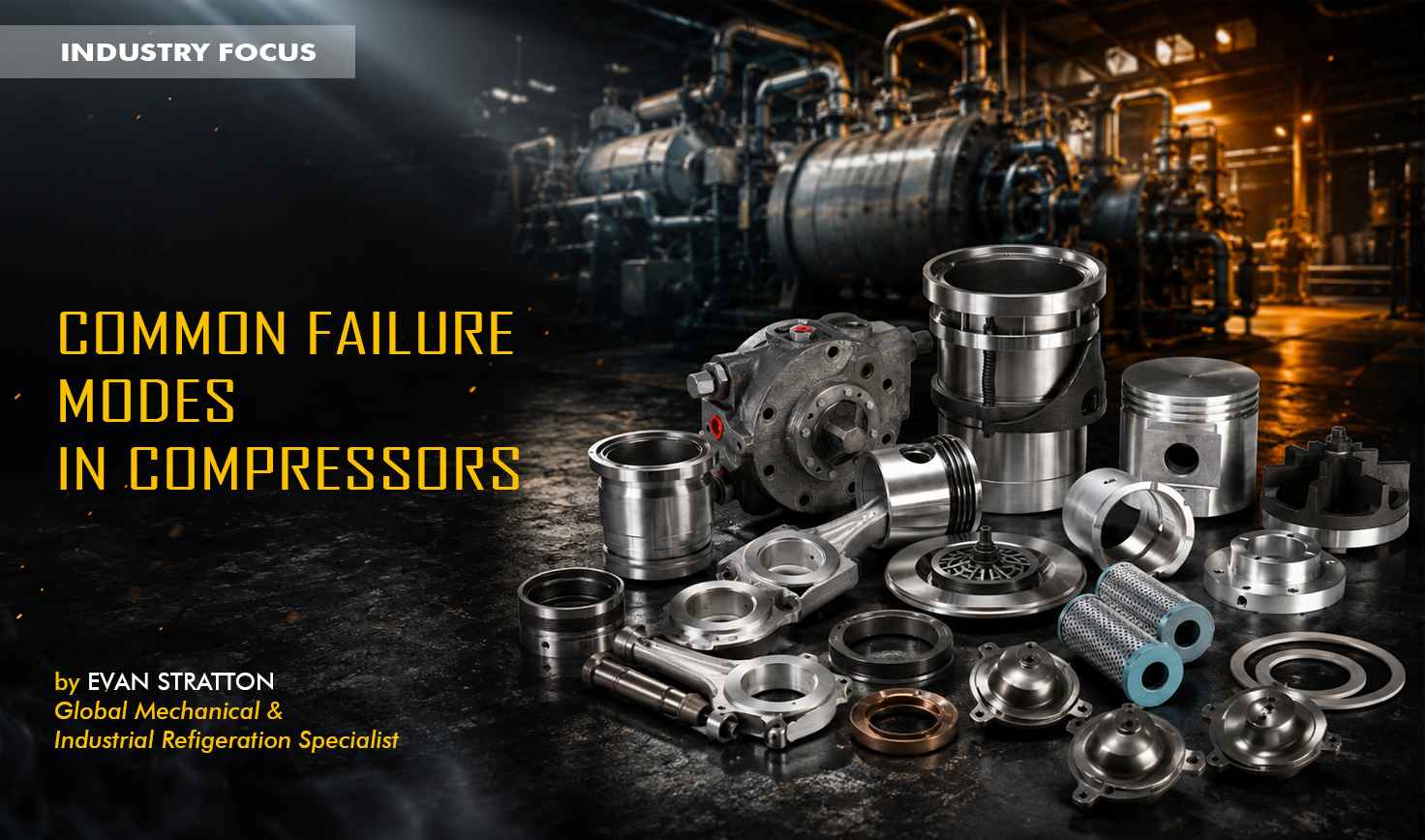
Common Failure Modes in Mycom, Sabroe, Grasso & Vilter Compressors
The K9 Reliability Series – Practical engineering insights from professionals who have spent decades inside compressor rooms—not behind desks.
Common Failure Modes in Mycom, Sabroe, Grasso, and Vilter Compressors: Causes, Prevention & Best Practices
by Evan Stratton
Global Mechanical Reliability & Industrial Refrigeration Specialist (Compressors Focus)
I’ve spent more than three decades working with industrial refrigeration systems across North America, Europe, Southeast Asia, Australia, and India. During those years, I’ve walked into compressor rooms that looked immaculate and others that had clearly seen better days. And every time I would get more curious about the Common Failure Modes in Mycom, Sabroe, Grasso, and Vilter Compressors.
Interestingly, the compressors rarely failed because they were poorly designed.
They failed because small warning signs went unnoticed.
Whether I was inspecting a Mycom reciprocating compressor in a seafood processing plant or helping troubleshoot a Vilter unit in a pharmaceutical warehouse, the pattern remained surprisingly consistent.
Major failures almost always started as minor ones.
A slightly worn bearing.
A valve plate showing early fatigue.
A shaft seal is beginning to leak.
None of those issues looked dramatic on day one. Left alone, however, they often became expensive shutdowns.
That’s exactly why understanding the Common Failure Modes in Mycom, Sabroe, Grasso, and Vilter Compressors matters. When you know what typically fails—and why—you stop reacting to breakdowns and start preventing them.
And that’s where maintenance teams win.
Compressor Failures Rarely Arrive Without Warning
One misconception still surprises me.
Many people believe compressors simply “fail.”
In reality, they usually don’t.
Compressors communicate long before they stop running.
The problem is that their language isn’t spoken through alarms.
It’s spoken through vibration.
Temperature changes.
Oil condition.
Noise.
Pressure fluctuations.
These are early conversations your equipment is trying to have with you.
Ignore them, and they’ll eventually become emergency shutdowns.
Listen carefully, and you’ll often prevent major repairs altogether.
I’ve seen maintenance departments reduce annual compressor failures significantly without buying new equipment.
They simply became better listeners.
-
Valve Plate Failures
If I had to nominate one component that deserves far more attention than it receives, it would be the valve plate.
I’ve replaced hundreds over the years.
Almost every reciprocating compressor eventually requires new valve plates.
Why?
Because they’re constantly working.
Every compression cycle opens and closes the valves thousands of times.
Hour after hour.
Day after day.
Eventually, fatigue wins.
Common causes include:
- Metal fatigue
- Liquid slugging
- Carbon deposits
- Excessive discharge temperatures
- Poor lubrication
When valve plates begin deteriorating, the symptoms usually appear gradually.
Capacity drops.
Power consumption increases.
Discharge temperatures rise.
Some operators blame the compressor.
I usually start with the valve plates.
More often than not, that’s exactly where the problem lives.
-
Bearing Failures
Here’s something I tell younger engineers during training.
Bearings seldom fail first.
Something else causes the bearing to fail.
That’s an important distinction.
In my experience, bearing damage usually begins with contaminated oil, inadequate lubrication, misalignment, or excessive vibration.
Once lubrication breaks down, metal contacts metal.
From there, deterioration accelerates quickly.
Typical warning signs include:
- Increasing vibration
- Rising bearing temperatures
- Metallic particles in oil
- Unusual operating noise
I’ve seen perfectly good compressors written off because a relatively inexpensive bearing wasn’t replaced during a planned shutdown.
That always feels avoidable.
Because it usually is.
-
Shaft Seal Leakage
Ask any refrigeration technician about nuisance problems, and shaft seals will almost certainly enter the conversation.
They’re small components.
Yet they protect one of the compressor’s most critical areas.
Over time, seals naturally age.
Heat hardens the sealing surfaces.
Pressure cycles create wear.
Tiny leaks eventually become visible.
Unfortunately, many facilities wait until refrigerant losses become obvious before acting.
That’s often too late.
Whenever I inspect compressors, I pay close attention to shaft seals.
They’re inexpensive compared to the downtime they can create.
If you catch them early, replacement remains straightforward.
Wait too long, and additional damage frequently follows.
-
Piston Rings and Cylinder Liners
Every reciprocating compressor depends on effective sealing inside the cylinder.
That’s the job of piston rings.
Like every moving component, they wear.
Sometimes slowly.
Sometimes surprisingly quickly.
Oil quality plays a huge role here.
So does filtration.
When contamination enters the lubrication system, piston rings begin wearing faster than expected.
Eventually, cylinder liners also suffer.
The result?
Reduced compression efficiency.
Higher operating temperatures.
Greater energy consumption.
I’ve watched plants spend weeks investigating declining compressor performance.
In the end, worn piston rings were responsible.
Simple problem.
Expensive delay.
Not Every Failure Starts Inside the Compressor
One mistake I still see involves focusing exclusively on compressor internals.
That’s understandable.
They’re the heart of the refrigeration system.
But compressors don’t operate alone.
- Oil coolers.
- Filters.
- Control valves.
- Pressure switches.
- Sensors.
Even something as ordinary as an oil filter can shorten compressor life if neglected.
That’s why experienced maintenance teams look beyond individual components.
They evaluate the entire operating environment.
Because healthy compressors rarely exist inside unhealthy systems.
-
Lubrication System Failures
If someone asked me to name the single biggest reason compressors suffer premature failures, my answer would be immediate.
Poor lubrication.
Over the years, I’ve seen perfectly healthy compressors destroyed because the oil system was ignored.
People often assume compressor oil has one job.
It doesn’t.
- It lubricates moving parts.
- It removes heat.
- It carries away contaminants.
- It protects surfaces from wear.
When that oil becomes contaminated, every component inside the compressor starts paying the price.
I’ve opened compressors where the bearings looked damaged. The crankshaft showed scoring. Valve plates appeared burnt.
Yet none of those parts caused the problem.
Dirty oil did.
The usual suspects include:
- Moisture contamination
- Dirty oil filters
- Incorrect oil viscosity
- Low oil pressure
- Oxidized lubricant
- Delayed oil changes
One maintenance manager once told me,
“We replace compressors every eight years.”
After reviewing their lubrication practices, I understood why.
The compressor wasn’t wearing out.
Their maintenance process was.
Simple improvements in oil analysis and filtration dramatically extended compressor life.
Sometimes the biggest gains come from the smallest habits.
-
Rotor Wear in Screw Compressors
Screw compressors don’t have pistons.
That doesn’t make them immune to wear.
Instead, their rotors become the heart of the machine.
Rotor damage is rarely sudden.
It develops slowly.
- Clearances increase.
- Efficiency decreases.
- Power consumption rises.
- Eventually, capacity begins falling.
I’ve inspected screw compressors where operators complained about reduced refrigeration performance.
Their first assumption?
“The compressor is old.”
It wasn’t.
The rotors had simply worn beyond acceptable tolerances.
Common causes include:
- Poor lubrication
- Dirty oil
- Bearing wear
- Foreign particle contamination
- Rotor contact caused by misalignment
Here’s something worth remembering.
Rotor repairs are rarely inexpensive.
Protecting them through proper lubrication and timely bearing replacement almost always costs less.
-
Control Components Deserve More Attention
Modern refrigeration systems depend heavily on sensors and controls.
Ironically, they’re often overlooked during routine maintenance.
- Pressure transmitters drift.
- Temperature sensors lose accuracy.
- Pressure switches stick.
- Solenoid valves become sluggish.
Individually, these seem like small issues.
Collectively, they create larger problems.
I’ve visited facilities where compressors repeatedly shut down without an obvious mechanical fault.
After several hours of investigation, the culprit turned out to be a pressure transmitter reading inaccurately.
Replacing a relatively inexpensive component eliminated weeks of frustration.
Sometimes the smartest troubleshooting starts with the simplest possibilities.
What Maintenance Teams Often Miss
Here’s something experience has taught me.
Maintenance isn’t just about replacing worn parts.
It’s about understanding why they wore out.
Suppose you replace a bearing.
Excellent.
Now ask yourself another question.
- Why did that bearing fail?
- Was lubrication inadequate?
- Did vibration increase?
- Was the alignment incorrect?
- Did contamination enter the oil system?
Unless the root cause disappears, the replacement bearing will eventually suffer the same fate.
I’ve watched this cycle repeat countless times.
The component changes.
The problem remains.
That’s why failure analysis matters.
It prevents history from repeating itself.
For more insights, you may also like to read from Industrial Learning
‘Common Causes of Compressor Failure and How to Prevent Them‘
Why OEM-Grade Spare Parts Really Matter
Over the years, I’ve been asked one question repeatedly.
“Do OEM-grade spare parts really make that much difference?”
My answer has never changed.
Yes.
And here’s why.
Industrial refrigeration compressors operate under extremely demanding conditions.
- Component tolerances matter.
- Material quality matters.
- Heat treatment matters.
- Surface finish matters.
Small differences become significant after thousands of operating hours.
I’ve seen inexpensive replacement parts installed during shutdowns simply because they were available quickly.
The compressor returned to service.
Everyone celebrated.
Six months later, it failed again.
The repair became twice as expensive.
Downtime lasted even longer.
Choosing quality components isn’t about paying more.
It’s about avoiding repeated work.
That’s a much better investment.
Finding the Right Supply Partner
During my visits to manufacturing facilities across India, Europe, and North America, I’ve noticed something encouraging.
The quality of OEM-grade compressor spare parts has improved significantly over the past decade.
One company I’ve come across while working with industrial refrigeration operators is K-nine Spares Pvt. Ltd.
(www.k9spares.com).
Their focus on OEM-grade replacement components for Mycom, Sabroe, Grasso, Vilter, Carrier, York, Frick, and other industrial refrigeration compressors reflects what today’s maintenance professionals expect from a reliable supplier.
Their product range includes valve plates, bearings, piston assemblies, shaft seals, gasket kits, oil pump components, cylinder liners, and overhaul kits manufactured for demanding industrial applications.
What impressed me wasn’t simply the product catalogue.
It was the emphasis on engineering consistency.
Because, in my experience, consistency is what keeps compressors running.
One of My many Experiences…
A few years ago, I was invited to review repeated compressor failures at a frozen seafood processing plant in Southeast Asia.
The facility operated several Sabroe reciprocating compressors supporting blast freezers and cold storage rooms.
Initially, everyone blamed equipment age.
The compressors had operated for years.
Naturally, they assumed replacement would soon become necessary.
However, a closer inspection told a different story.
Oil analysis revealed contamination.
Vibration monitoring identified early bearing deterioration.
During the planned shutdown, technicians also discovered cracked valve plates and worn piston rings.
Fortunately, the maintenance team had already stocked OEM-grade replacement components.
Everything required for the overhaul was available before dismantling began.
Within four days, every compressor returned to service.
The results surprised even the plant manager.
During the following twelve months, compressor-related downtime decreased by approximately 31%.
Emergency spare parts purchases dropped by nearly 24%.
Maintenance planning also became considerably more predictable.
When I spoke with the maintenance supervisor months later, he smiled and said,
“We finally stopped fighting the compressor and started understanding it.”
That conversation has stayed with me ever since.
Five Practical Lessons Every Maintenance Team Should Remember
If there’s one thing I’d like readers to take away from this article, it’s this.
Reliable compressors don’t happen by accident.
They result from consistent maintenance decisions.
My advice is straightforward.
- Listen to what your compressor is telling you.
- Never ignore small oil leaks.
- Treat vibration like an early warning system.
- Replace worn parts before they become failed parts.
- Invest in OEM-grade components whenever reliability matters.
None of these recommendations is revolutionary.
They simply work.
And after thirty-five years, I’ve learned to trust what consistently works.
You Ask…
- Which compressor component fails most frequently?
Valve plates, bearings, shaft seals, piston rings, and gaskets are among the most frequently replaced components in industrial refrigeration compressors because they experience continuous mechanical stress during operation.
- Can oil contamination really damage an entire compressor?
Absolutely.
Contaminated oil accelerates wear throughout the lubrication system. Bearings, crankshafts, rotors, and valve components all depend on clean oil for reliable operation.
- How often should compressors undergo condition monitoring?
Critical refrigeration compressors should undergo routine vibration analysis, oil analysis, and performance inspections at planned intervals based on operating hours and plant criticality.
- Are OEM-grade spare parts worth the additional investment?
In nearly every facility I’ve visited, yes.
OEM-grade parts provide better fit, material consistency, and reliability, helping reduce repeat failures and lowering long-term maintenance costs.
- Which maintenance practice delivers the greatest return?
If I had to choose one, it would be proactive condition monitoring.
Detecting problems early almost always costs less than repairing catastrophic failures after they occur.
Final Thoughts
After more than three decades of working alongside maintenance engineers across five continents, one truth has remained remarkably consistent.
Compressors rarely fail without leaving clues.
The challenge isn’t finding those clues.
It’s recognizing them before production suffers.
Whether your facility operates Mycom, Sabroe, Grasso, or Vilter compressors, the fundamentals never change. Protect your lubrication system, monitor vibration trends, replace worn components before failure, and insist on OEM-grade spare parts from trusted suppliers. These simple practices consistently deliver better reliability, lower maintenance costs, and greater confidence during every shutdown.
The best maintenance teams don’t wait for failures—they prevent them.
If you’re planning an overhaul, reviewing your spare parts inventory, or looking for reliable OEM-grade replacement components, now is the ideal time to act.
👉 Request a Quote from K-nine Spares and discover how precision-engineered compressor spare parts can help maximize uptime, improve reliability, and keep your industrial refrigeration systems operating at peak performance.
About the Author
Evan Stratton is a Global Mechanical Reliability & Industrial Refrigeration Specialist with over three decades of experience in compressor diagnostics, asset reliability, and maintenance strategy. His work has supported industrial refrigeration operations across North America, Europe, Southeast Asia, and India.
The opinions expressed in this article are the author’s own. This website has made editorial changes only for readability, grammar, and presentation, without altering the author’s intended meaning.
From the K-Nine Engineering Desk
Every Engineering Paper is written to help refrigeration engineers make better maintenance decisions based on practical field experience and precision manufacturing knowledge.
If there’s a compressor component or maintenance topic you’d like us to cover, let us know. It might become the next Engineering Paper.