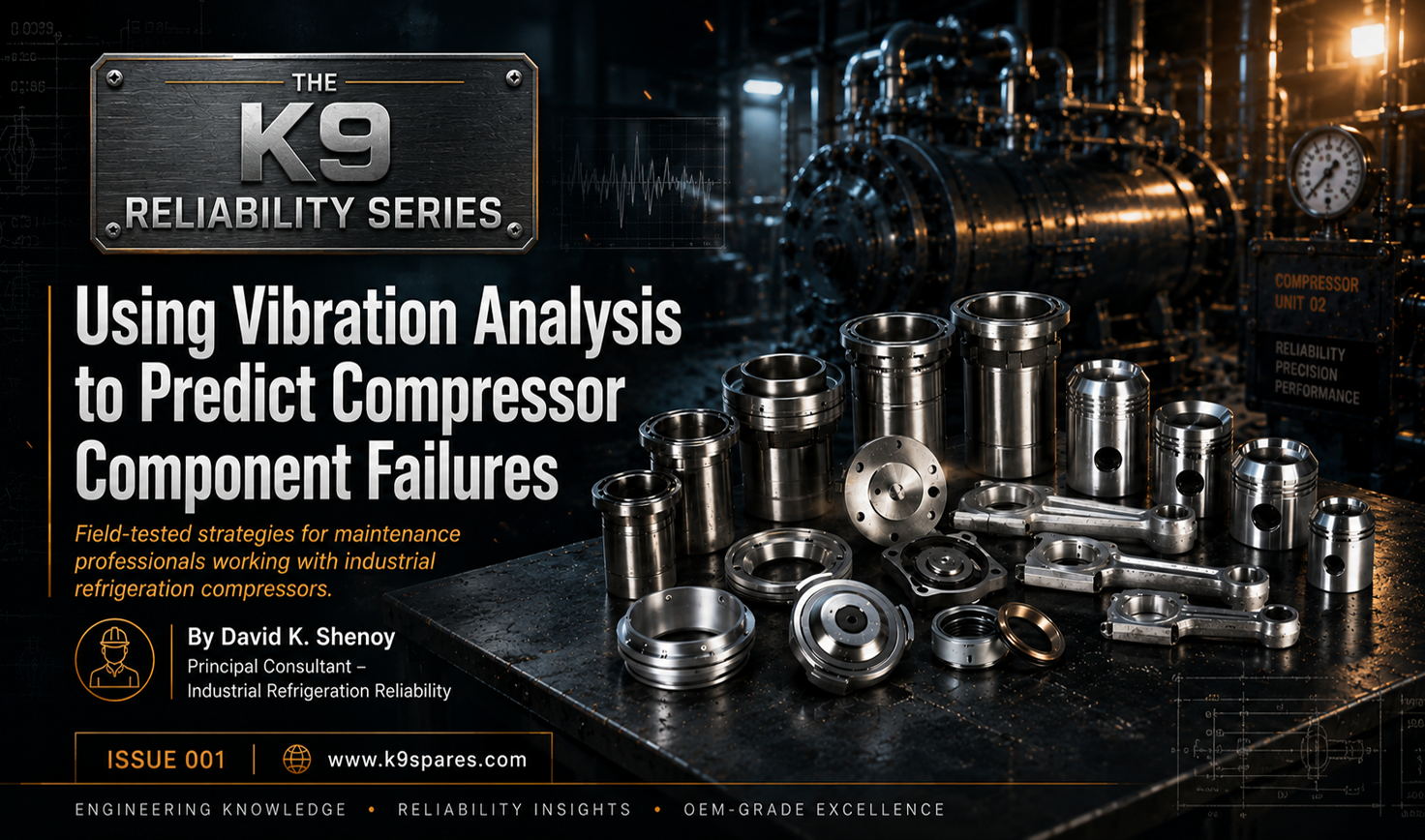
Using Vibration Analysis to Predict Compressor Component Failures
The K9 Reliability Series – Practical engineering insights for maintenance professionals, reliability engineers, and procurement leaders who keep industrial refrigeration running.
From David’s Desk
- Every compressor has a story to tell.
- Some whisper through vibration.
- Others through temperature.
- The smartest maintenance teams learn to listen before failure forces them to.
This month’s Reliability Series explores one of the most valuable predictive tools available today—vibration analysis.
Vibration Analysis
By David K. Shenoy
Principal Consultant – Compressor Reliability & Industrial Refrigeration Systems
One lesson has stayed with me throughout my career.
Compressors rarely fail without speaking first.
The problem is that most people don’t understand their language.
For more than thirty-five years, I’ve worked with industrial refrigeration compressors in food processing plants, cold storage warehouses, pharmaceutical facilities, and manufacturing operations across several countries.
Whether the machine carried the name Mycom, Sabroe, Grasso, Vilter, Carrier, or York, one thing remained remarkably consistent.
Every compressor gave warning signs before failure.
- Some whispered.
- Some practically shouted.
The challenge wasn’t collecting data.
The challenge was knowing what the data meant.
That is exactly where vibration analysis becomes invaluable.
It allows maintenance teams to identify developing problems long before those problems become expensive shutdowns.
And believe me, there are few feelings more satisfying than preventing a failure that everyone else thought was inevitable.
Why Vibration Analysis Matters More Than Ever
When I began my career, most maintenance teams depended heavily on experience.
- They listened to compressors.
- They touched the bearing housings.
- They smelled overheated oil.
Those instincts remain valuable today.
However, modern facilities cannot rely on instinct alone.
- Production schedules have become tighter.
- Downtime costs have increased dramatically.
- Maintenance windows continue shrinking.
Every hour counts.
Vibration analysis gives maintenance teams something experience alone cannot provide.
Objective evidence.
Instead of wondering whether a bearing is beginning to wear, vibration monitoring helps confirm it.
Instead of guessing whether alignment has changed, vibration trends reveal the answer.
This transforms maintenance from reactive to predictive.
That shift changes everything.
Every Compressor Has Its Own Signature
One misconception I often encounter is this.
People expect every failing compressor to vibrate in the same way.
That simply isn’t true.
Healthy compressors produce vibration.
That’s perfectly normal.
The important question isn’t whether vibration exists.
It’s whether the vibration is changing.
Think of it like monitoring a person’s heartbeat.
A heartbeat is expected.
An unusual rhythm deserves attention.
Compressors behave much the same way.
The goal isn’t eliminating vibration.
The goal is understanding what changed—and why.
Once maintenance teams begin trending vibration data over time, patterns emerge.
Those patterns often identify problems weeks before operators notice performance losses.
The Most Common Problems Vibration Analysis Detects
Over the years, vibration monitoring has consistently helped me identify several recurring issues before major failures occurred.
Let’s look at the most common ones.
1. Bearing Wear
Bearings rarely fail overnight.
Instead, microscopic surface damage develops gradually.
As the damage increases, vibration frequencies change.
Initially, those changes appear insignificant.
Weeks later, they become impossible to ignore.
I’ve prevented numerous catastrophic failures simply because bearing vibration increased slightly during routine monitoring.
Replacing one bearing during a planned shutdown costs very little.
Replacing an entire compressor does not.
2. Shaft Misalignment
Alignment problems often develop after maintenance work.
- Sometimes the equipment settles.
- Sometimes pipe strain changes alignment.
Occasionally, installation errors go unnoticed.
Misalignment increases axial vibration.
Couplings begin wearing faster.
Bearings experience additional stress.
Energy consumption often rises.
Fortunately, vibration analysis identifies these problems quickly.
Correcting alignment early prevents much larger repairs later.
3. Rotor Imbalance
Every rotating assembly depends on balance.
Even a minor imbalance creates centrifugal forces that grow with speed.
Operators frequently describe these compressors as “rough.”
Vibration data explains why.
Rotor imbalance usually develops due to wear, contamination, damaged components, or prior repairs.
Balancing the rotating assembly restores smoother operation while reducing stress throughout the compressor.
4. Mechanical Looseness
Loose foundation bolts rarely attract attention.
Until they do.
I’ve visited plants where technicians replaced bearings twice.
The vibration remained.
Eventually, someone inspected the mounting hardware.
Several anchor bolts had loosened over time.
That simple discovery solved months of recurring problems.
Never underestimate basic inspections.
Experience has taught me that sophisticated diagnostics and simple observations often work best together.
5. Valve Plate Damage
Valve plates produce distinctive vibration signatures as fatigue develops.
Initially, refrigeration performance appears normal.
Capacity losses remain small.
However, vibration patterns begin changing well before operators notice reduced efficiency.
When maintenance teams recognize those signatures early, valve replacement becomes scheduled work rather than an emergency repair.
That’s exactly how predictive maintenance should function.
Reading the Story Behind the Numbers
One mistake I see repeatedly is focusing only on vibration values.
Numbers matter.
Trends matter even more.
Suppose overall vibration increases by ten per cent.
Should you panic?
Not necessarily.
Instead, ask better questions.
- Which frequency changed?
- When did it begin?
- Did oil analysis reveal contamination?
- Has the discharge temperature increased?
- Was maintenance recently performed?
Vibration analysis becomes powerful only when combined with other maintenance information.
The complete picture always tells a better story than one measurement alone.
Practical Guide: Common Vibration Symptoms
| Observed Vibration Pattern | Likely Component | Most Probable Cause | Recommended Action |
| High-frequency vibration increases | Bearings | Lubrication breakdown or wear | Inspect bearings and analyse oil condition |
| Elevated axial vibration | Coupling / Shaft | Misalignment | Check shaft alignment and pipe strain |
| Cyclic impact peaks | Valve Plate | Fatigue or cracked valves | Inspect valve assembly during shutdown |
| Rising overall vibration | Rotor / Crankshaft | Imbalance | Perform balancing and mechanical inspection |
| Random vibration spikes | Foundation / Fasteners | Mechanical looseness | Tighten fasteners and inspect mounting |
Don’t Wait for the Alarm
One of the biggest misconceptions in maintenance is believing that alarms provide enough warning.
They usually don’t.
By the time most alarms activate, the fault has already progressed significantly.
Vibration monitoring works differently.
- It identifies trends.
- It detects deterioration while maintenance teams still have options.
That’s the real value.
Not predicting failure tomorrow.
Preventing failure next month.
Or next quarter.
And that’s where the biggest savings usually occur.
Engineering Tip
“Vibration analysis doesn’t tell you which part to replace. It tells you where to start looking. The final diagnosis always comes from combining vibration trends with oil analysis, visual inspection, operating history, and engineering judgement“.
— David K. Shenoy
Building a Practical Vibration Monitoring Program
People often ask me where to begin.
- Do they need sophisticated software?
- Expensive sensors?
- A dedicated reliability engineer?
My answer usually surprises them.
Start with consistency.
I’ve seen modest maintenance teams outperform larger facilities because they collected reliable data every month.
The process doesn’t need to be complicated.
It needs to be repeatable.
Choose the same measurement points every time.
Record readings under similar operating conditions.
Compare today’s results with last month’s trends.
Above all, don’t wait for vibration levels to become alarming.
Small deviations usually tell the most important story.
A good monitoring program becomes even more powerful when combined with routine inspections, oil analysis, and maintenance history.
The more pieces of the puzzle you collect, the clearer the picture becomes.
Why One Tool Is Never Enough
Over the years, I’ve learned something that every experienced reliability engineer eventually discovers.
No single diagnostic tool has all the answers.
Vibration analysis is incredibly powerful.
Yet it works best alongside other predictive maintenance techniques.
- Oil analysis reveals internal wear.
- Thermography identifies overheating.
- Ultrasonic testing detects leaks.
- Performance trending highlights efficiency losses.
Put these together, and the compressor begins telling a complete story.
I often compare it to visiting a doctor.
A diagnosis isn’t based on one test alone.
It’s based on several observations pointing toward the same conclusion.
Industrial refrigeration should be no different.
The best maintenance decisions come from multiple sources of evidence.
Predictive Maintenance Is About Confidence
Some people believe predictive maintenance exists simply to reduce downtime.
That’s only part of the story.
The real advantage is confidence.
Imagine planning a compressor overhaul six weeks in advance because vibration data shows a bearing beginning to deteriorate.
- The spare parts arrive on time.
- Labour is scheduled.
- Production adjusts accordingly.
- The overhaul finishes during a planned shutdown.
Now compare that with a bearing failure on a Friday evening.
- Emergency procurement begins.
- Production stops.
- Costs escalate by the hour.
Same bearing.
Very different outcome.
Predictive maintenance doesn’t eliminate failures.
It allows you to choose when they happen.
That changes everything.
Why Quality Spare Parts Still Matter
Even the best diagnostic program cannot compensate for poor replacement components.
I’ve seen facilities invest heavily in condition monitoring, only to install low-quality spare parts during an overhaul.
Six months later, they faced the same problems again.
The data wasn’t wrong.
The replacement components simply couldn’t deliver long-term reliability.
This is particularly important for bearings, valve plates, piston assemblies, shaft seals, oil pump components, and gasket kits.
- Dimensional accuracy matters.
- Material quality matters.
- Heat treatment matters.
- Manufacturing consistency matters.
When these factors align, compressors operate more smoothly, vibration levels remain stable, and maintenance intervals become far more predictable.
That’s exactly what every reliability engineer wants.
Supporting Reliability Beyond the Compressor Room
During my consulting assignments across Asia, Europe, and North America, I’ve often been asked where maintenance teams should focus their attention after improving condition monitoring.
My answer remains the same.
Strengthen your spare parts strategy.
Reliable maintenance doesn’t end with accurate diagnostics.
It depends equally on having dependable replacement components available when they’re needed.
One company I’ve come across repeatedly in industrial refrigeration circles is K-nine Spares
Their focus on OEM-grade compressor spare parts supports facilities operating Mycom, Sabroe, Grasso, Vilter, York, Carrier, Frick, and several other industrial refrigeration compressor brands.
From valve plates and bearing kits to piston assemblies, shaft seals, oil pumps, cylinder liners, and overhaul components, their portfolio reflects the practical needs of maintenance professionals planning reliable shutdowns.
- Good diagnostics identify the problem.
- Quality spare parts complete the solution.
The two should always work together.
In Reality…
Several years ago, I worked with a pharmaceutical cold-chain facility experiencing intermittent vibration alarms on one of its reciprocating compressors.
The equipment continued operating normally.
Production managers preferred waiting until the next annual shutdown.
However, the vibration trend told a different story.
A gradual increase appeared in the bearing frequencies over several weeks.
Oil analysis also detected a slight rise in metallic particles.
Neither result looked dramatic on its own.
Together, they painted a clear picture.
The maintenance team decided to inspect the compressor during a scheduled weekend shutdown.
The investigation confirmed early-stage bearing wear and slight shaft misalignment.
Fortunately, OEM-grade replacement bearings and alignment components were already available.
The repair finished within the planned maintenance window.
During the following twelve months, compressor-related downtime fell by approximately 29%, while emergency maintenance costs decreased by nearly 21%.
When I met the maintenance supervisor later that year, he smiled and said,
“The vibration monitor paid for itself long before accounting realized it.”
I couldn’t have summarized predictive maintenance any better.
Five Lessons I’ve Learned About Vibration Analysis
After more than 3 decades of working with industrial refrigeration compressors, these principles have never let me down.
- Every compressor develops its own vibration fingerprint.
- Trends matter far more than isolated readings.
- Small changes deserve attention before they become major failures.
- Vibration analysis works best alongside oil analysis and visual inspections.
- Reliable spare parts complete every successful predictive maintenance strategy.
They’re simple ideas.
Yet they’ve prevented countless unplanned shutdowns.
Commonly Asked by Maintenance Engineers
1. Can vibration analysis predict every compressor failure?
No.
However, it detects many developing mechanical problems long before they become operational failures. Combined with oil analysis and routine inspections, it provides an excellent early-warning system.
2. How frequently should vibration readings be collected?
Critical industrial refrigeration compressors should be monitored monthly or according to operating criticality. Facilities with demanding production schedules may benefit from more frequent condition monitoring.
3. Does vibration analysis work for both reciprocating and screw compressors?
Absolutely.
Although vibration patterns differ, both compressor types exhibit measurable changes as bearings, rotors, valve assemblies, or other components begin to deteriorate.
4. Is vibration monitoring only useful for large facilities?
Not at all.
Even smaller refrigeration plants benefit significantly from identifying developing failures before emergency shutdowns interrupt production or damage expensive compressor components.
5. Should vibration analysis replace preventive maintenance?
No.
It should strengthen preventive maintenance, not replace it. Predictive tools help maintenance teams make better decisions about when work should be performed.
Final Thoughts
One lesson has remained remarkably consistent throughout my career.
Machines rarely surprise us.
More often than not, they warn us.
The question is whether we’re paying attention.
Vibration analysis gives maintenance teams the opportunity to detect developing faults while they are still manageable, affordable, and predictable. Combined with regular inspections, oil analysis, thermography, and high-quality OEM-grade spare parts, it becomes one of the most valuable investments any industrial refrigeration facility can make.
Whether your operation relies on Mycom, Sabroe, Grasso, Vilter, Carrier, York, or Frick compressors, the objective remains unchanged—maximize uptime, extend equipment life, and eliminate unnecessary surprises.
If you’re planning your next overhaul or reviewing your predictive maintenance strategy, now is the ideal time to evaluate both your condition monitoring practices and your spare parts inventory.
👉 Request a Quote from K-nine Spares and discover how precision-engineered OEM-grade compressor spare parts can support reliable, long-term compressor performance.
About the Author
David K. Shenoy
Principal Consultant – Compressor Reliability & Industrial Refrigeration Systems
David K. Shenoy is a veteran industrial refrigeration consultant with more than 35 years of experience in compressor diagnostics, predictive maintenance, vibration analysis, and asset reliability. Throughout his career, he has worked with maintenance teams across food processing, cold storage, pharmaceutical logistics, and industrial manufacturing facilities in Asia, Europe, North America, and the Middle East. His practical, field-tested approach helps organizations reduce unplanned downtime, improve compressor reliability, and build maintenance strategies focused on long-term operational excellence.
The opinions expressed in this article are the author’s own. This website has made editorial changes only for readability, grammar, and presentation, without altering the author’s intended meaning.
From the K-Nine Engineering Desk
Every Engineering Paper is written to help refrigeration engineers make better maintenance decisions based on practical field experience and precision manufacturing knowledge.
If there’s a compressor component or maintenance topic you’d like us to cover, let us know. It might become the next Engineering Paper.

Contributors
David K. Shenoy – Reliability Engineering
Evan Stratton – Compressor Systems
Michael Thornton – Asset Management
Sabah Connoley – Energy Efficiency
Dr L. Wang – Diagnostics
James O’Connor – Plant Maintenance