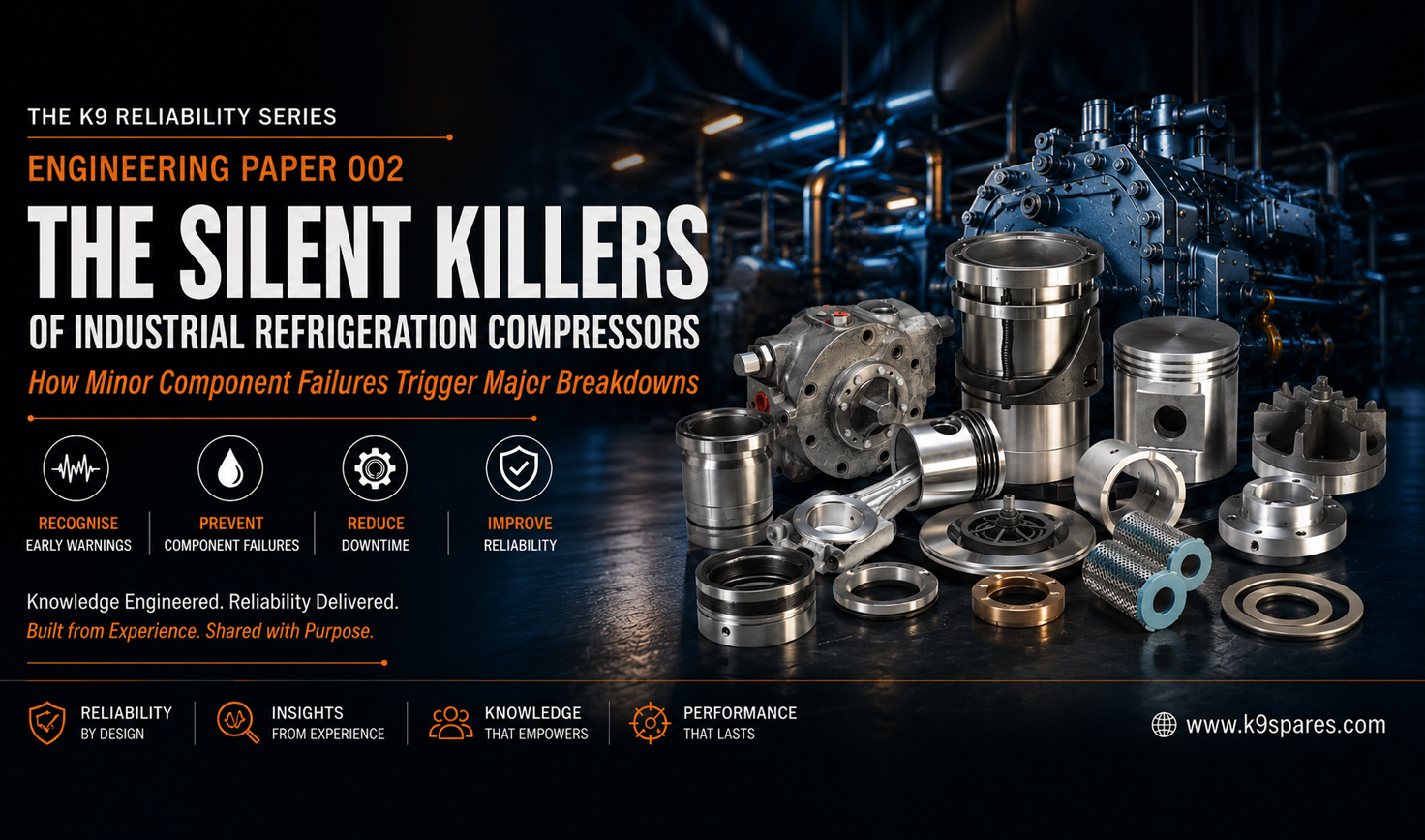
The Silent Killers of Industrial Refrigeration Compressors
About The K9 Reliability Series
The K9 Reliability Series is an educational initiative by K9 Spares, created to advance practical engineering knowledge within the industrial refrigeration industry.
Rather than focusing on products, each Engineering Paper explores the principles, maintenance strategies and reliability practices that help engineers improve equipment performance, reduce downtime and make informed maintenance decisions.
Every paper is guided by one philosophy.
Knowledge Engineered. Reliability Delivered.
Built from Experience. Shared with Purpose.
How Minor Component Failures Trigger Major Breakdowns
By David K. Shenoy
Principal Consultant – Industrial Refrigeration Reliability
Before You Begin Reading
Industrial refrigeration compressors rarely fail without warning.
The warning signs usually appear long before production stops.
The challenge lies in recognizing those signs while everything still appears normal.
This Engineering Paper has been created for maintenance supervisors, plant managers, reliability engineers and procurement professionals who believe that preventing a failure is always more rewarding than repairing one.
Read it.
Discuss it with your maintenance team.
Share it with your colleagues.
Most importantly…
Apply it.
From David’s Desk
“Over the past three decades, I have investigated hundreds of compressor failures across cold storage facilities, food processing plants and pharmaceutical warehouses.
Every catastrophic failure looked different.
A fractured crankshaft.
A seized bearing.
A shattered valve plate.
A damaged connecting rod.
Yet they all had one thing in common.
None of them failed overnight.
Each machine had been giving small warnings for days, weeks or sometimes months.
The warning signs were never the problem.
Ignoring them was.
This Engineering Paper is about recognizing those small warnings before they become expensive lessons.
It is because catastrophic failures rarely begin catastrophically.
They begin quietly.”
— David K. Shenoy
Snapshot
Industry Focus
Industrial Refrigeration
Applicable Compressors
Mycom • Sabroe • Grasso • Vilter • Frick • York • Carrier • Bitzer and other leading industrial reciprocating compressors
Best Suited For
- Maintenance Supervisors
- Reliability Engineers
- Plant Managers
- Procurement Specialists
- Service Engineers
Introduction
Imagine walking into your compressor room on a Monday morning.
Production has already started.
The machine sounds normal.
Suction pressure looks acceptable.
Oil pressure remains stable.
Everything appears healthy.
Three weeks later, the same compressor suffers a catastrophic bearing failure.
Production stops.
Maintenance teams scramble.
Procurement begins searching for emergency spare parts.
Management wants immediate answers.
The obvious question becomes…
“Why did the compressor fail?”
The better question is…
“What did the compressor try telling us three weeks earlier?”
That subtle change in thinking separates reactive maintenance from reliability engineering.
Experienced maintenance professionals understand that compressors rarely surprise anyone.
Instead, they communicate continuously through vibration, temperature, lubrication, sound and operating performance.
The problem isn’t that machines fail silently.
The problem is that their earliest warnings often blend into everyday operating noise.
Small changes appear insignificant.
Maintenance gets postponed.
Production schedules take priority.
Minor defects quietly become major failures.
By the time the damaged component becomes visible, the real cause has already disappeared.
Understanding these silent killers helps maintenance teams interrupt failure long before expensive repairs become unavoidable.
That is where reliability engineering truly begins.
The First Silent Killer: Progressive Bearing Wear
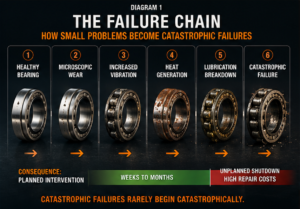
Bearings rarely fail suddenly.
They deteriorate gradually.
Microscopic surface damage appears first.
Lubrication begins to lose effectiveness.
Rolling elements develop tiny imperfections.
Those imperfections increase vibration levels.
Initially, the changes remain almost impossible to detect without condition monitoring.
Over time, however, vibration frequencies become increasingly consistent.
This is precisely why vibration analysis remains one of the most valuable predictive maintenance tools available to refrigeration plants.
A simple vibration trend often reveals bearing deterioration weeks before temperature rises or audible noise becomes noticeable.
Plants that monitor vibration regularly replace bearings during scheduled shutdowns.
Plants that ignore vibration usually replace bearings after production has already stopped.
David’s Field Note – “Bearings rarely ask for attention twice.”
The Failure Chain – How Small Problems Become Catastrophic Failures
The Second Silent Killer: Lubrication Contamination
Ask any experienced compressor overhaul engineer what destroys components faster than anything else, and the answer is surprisingly consistent.
It’s not an overload.
Neither age.
Not even poor operating conditions.
Contaminated oil.
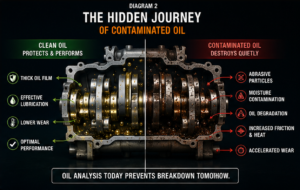
Lubricating oil performs far more functions than simply reducing friction.
It cools bearings.
Protects moving surfaces.
Carries away microscopic wear particles.
Maintains hydraulic sealing.
Transfers heat.
The moment contamination enters this system, every lubricated component begins operating under compromised conditions.
Moisture, metal particles, degraded oil, carbon deposits and refrigerant dilution slowly reduce the oil’s ability to perform these critical tasks.
Initially, compressors continue operating almost normally.
Oil pressure may remain acceptable.
Temperatures may appear stable.
Operators notice nothing unusual.
Yet inside the machine, microscopic wear accelerates.
Bearing clearances increase.
Oil films become thinner.
Heat generation rises.
Every hour of operation quietly compounds the damage.
By the time the oil appears visibly contaminated, irreversible wear has often already begun.
Routine oil analysis remains one of the simplest and most cost-effective predictive maintenance tools available.
A laboratory report costing a fraction of a compressor overhaul can reveal problems months before they become catastrophic.
David’s Field Note – “Oil never lies. If you want to understand the health of a compressor, start by understanding the condition of its lubricant.”
The Hidden Journey of Contaminated Oil
The Third Silent Killer: Valve Plate Fatigue
Valve plates operate thousands of times every minute.
Every opening and closing cycle creates microscopic stress.
Under ideal operating conditions, these stresses remain well within safe limits.
However, compressors rarely spend their entire lives under ideal conditions.
High discharge temperatures.
Liquid slugging.
Improper unloading.
Pressure fluctuations.
Repeated start-stop cycles.
Each event introduces additional fatigue into the valve assembly.
Small surface cracks begin developing.
Performance losses remain almost impossible to detect initially.
Capacity slowly decreases.
Power consumption rises slightly.
Discharge temperatures increase.
Eventually, a tiny crack propagates across the valve plate.
One section breaks away.
Fragments circulate through the compressor.
What began as a microscopic crack has now become widespread mechanical damage.
Replacing a valve plate during a planned shutdown costs very little compared to rebuilding an entire compressor after internal fragmentation.
The lesson is remarkably simple.
Valve plates almost always provide opportunities for intervention.
Someone simply has to recognize them.
David’s Field Note – “Metal rarely breaks because it is weak. It breaks because fatigue has been quietly accumulating for a very long time.”
The Fourth Silent Killer: Shaft Seal Leakage
Few maintenance teams consider a minor shaft seal leak an emergency.
After all…
The compressor still runs.
Capacity remains acceptable.
Production continues.
Unfortunately, shaft seals rarely remain “minor.”
A small refrigerant leak often introduces a chain of secondary problems.
Lubricant escapes.
Air and moisture enter the system.
Oil chemistry changes.
Contamination increases.
Lubrication performance gradually declines.
Each individual effect appears manageable.
Collectively, they accelerate wear throughout the compressor.
Reliability engineering teaches an important lesson.
Problems should never be judged by their current size.
They should be judged by the consequences of ignoring them.
The Domino Effect of Minor Failures

The Reliability Mindset
One observation has remained remarkably consistent throughout my career.
Plants experiencing the fewest catastrophic failures rarely possess better compressors.
They possess better maintenance habits.
Their teams investigate unusual vibration before it becomes excessive.
They analyse oil instead of replacing components blindly.
They schedule inspections before production forces emergency repairs.
Most importantly, they understand that reliability is not created during an overhaul.
It is created every day through hundreds of seemingly ordinary maintenance decisions.
Reliability is never accidental.
It is engineered.
K9 Decision Point™
Imagine discovering a slight increase in compressor vibration during a routine inspection.
Production demand is high.
The compressor continues operating normally.
What should happen next?
Reactive Maintenance
“Let’s wait until the next scheduled shutdown.”
Reliability Engineering
“Let’s investigate now while the machine is still giving us the opportunity.”
The second decision almost always costs less.
Real-World Case Study
A food processing facility reported a recurring increase in vibration on one of its industrial refrigeration compressors.
The vibration level remained below alarm limits, so production continued uninterrupted.
During a planned maintenance shutdown three weeks later, technicians inspected the machine and discovered early-stage bearing wear caused by lubrication contamination.
The bearing, oil filter and lubricant were replaced during the scheduled outage.
Total maintenance time:
Eight hours.
Estimated repair cost:
Routine maintenance budget.
Had the compressor continued operating for another month, engineers estimated that bearing seizure would likely have damaged the crankshaft and connecting rods, extending downtime from hours to several days.
The investigation reinforced a lesson every reliability engineer eventually learns:
The cheapest repair is almost always the one completed before failure occurs.
Procurement Perspective
Maintenance and procurement often view compressor reliability from different angles.
Maintenance teams focus on restoring equipment performance.
Procurement teams focus on ensuring the right components are available at the right time and at the right cost.
The most successful organizations recognize that these objectives are closely connected.
Waiting for a catastrophic failure before sourcing replacement components almost always increases overall maintenance costs.
Emergency purchases frequently involve premium pricing, expedited logistics, extended production losses and limited supplier choices.
Reliability-focused plants adopt a different strategy.
Critical wear components—including bearings, valve plates, piston rings, shaft seals, gaskets and lubrication filters—are identified through failure history and condition monitoring trends.
Rather than reacting to breakdowns, they prepare for planned maintenance.
The result is lower downtime, reduced procurement pressure and significantly improved equipment availability.
In reliability engineering, procurement is not merely a purchasing function.
It is a strategic contributor to plant reliability.
David’s Reliability Checklist
Before approving another month of compressor operation, ask these seven questions.
✔ Have vibration levels changed since the previous inspection?
✔ Has the lubricating oil been analyzed recently?
✔ Are discharge temperatures trending upward?
✔ Has compressor capacity changed unexpectedly?
✔ Are shaft seals showing any early signs of leakage?
✔ Are suction and discharge pressures behaving consistently?
✔ Do maintenance records indicate recurring issues?
If even one answer raises concern…
Investigate.
Compressors are remarkably forgiving.
Ignoring them is not.
You Ask, David Answers…
-
Can catastrophic compressor failures really be prevented?
Not every failure can be prevented.
However, the overwhelming majority provide measurable warning signs well before catastrophic damage occurs.
Routine condition monitoring significantly improves the opportunity for planned intervention.
-
Which predictive maintenance technique provides the earliest warning?
No single technique is sufficient on its own.
The most effective reliability programs combine vibration analysis, oil analysis, temperature monitoring, operating performance trends and routine visual inspections.
Together, they create a far more complete picture of compressor health.
-
Is vibration analysis useful even when the compressor appears to operate normally?
Absolutely.
Many bearing and mechanical defects become detectable through vibration long before they produce audible noise or noticeable performance loss.
Early detection allows maintenance to be scheduled rather than forced by failure.
-
Why do seemingly minor component failures become expensive breakdowns?
Small defects rarely remain isolated.
Once lubrication deteriorates, vibration increases or operating temperatures rise, additional components begin experiencing accelerated wear.
Stopping the failure chain early prevents widespread mechanical damage.
-
How often should industrial refrigeration compressors undergo condition monitoring?
Inspection frequency depends on operating hours, production criticality and equipment history.
However, facilities with high production dependence generally benefit from regular vibration analysis, routine oil sampling and systematic trend monitoring as part of their preventive maintenance program.
Final Thought
During every compressor overhaul, technicians eventually reach the damaged component.
The bearing.
The valve plate.
The shaft seal.
The crankshaft.
Those components deserve attention.
But they also deserve one important question.
“What happened before this?”
Because the damaged component is rarely the beginning of the story.
It is usually the final chapter.
Reliability engineers understand that failures are not isolated events.
They are conclusions.
The real work begins much earlier.
With observation.
With curiosity.
With disciplined maintenance.
And with the willingness to act before failure forces the decision.
Conclusion
Industrial refrigeration compressors seldom fail without providing opportunities for intervention.
They communicate continuously through measurable changes in vibration, lubrication, temperature and operating behavior.
Plants that recognize these signals early enjoy higher reliability, lower maintenance costs and fewer unplanned shutdowns.
Ultimately, reliability is not determined by the size of a compressor or the reputation of its manufacturer.
It is determined by the quality of the decisions made long before failure occurs.
Every inspection.
Every vibration reading.
Every oil sample.
Every maintenance decision.
Those ordinary actions quietly determine whether tomorrow becomes another productive day—or an expensive lesson.
“Machines rarely fail without warning.
>Our responsibility is to recognize the warning while there is still time to respond.”
— David K. Shenoy
About the Author
David K. Shenoy is an editorial expert who created The K9 Reliability Series. He represents the collective knowledge, practical experience, and engineering judgment of seasoned industrial refrigeration professionals.
Every Engineering Paper is built on established engineering principles, field-proven maintenance practices, and real-world reliability concepts. David’s voice exists to present that knowledge in a consistent, practical, and experience-driven manner.
His purpose is simple:
To help maintenance professionals make better engineering decisions.
The opinions expressed in this article are the author’s own. This website has made editorial changes only for readability, grammar, and presentation, without altering the author’s intended meaning.
From the K-Nine Engineering Desk
Every Engineering Paper is written to help refrigeration engineers make better maintenance decisions based on practical field experience and precision manufacturing knowledge.
If there’s a compressor component or maintenance topic you’d like us to cover, let us know. It might become the next Engineering Paper.
If this Engineering Paper helped you think differently about compressor reliability…
…then it has achieved its purpose.
When the time comes to source dependable OEM-grade compressor spare parts compatible with Mycom, Sabroe, Grasso, Vilter, Frick, York, Carrier, Bitzer and other leading industrial refrigeration compressors, the K-nine Spares team will be ready to help.
Until then…
Keep listening to your machines.
They usually tell you everything you need to know.

Contributors
David K. Shenoy – Reliability Engineering
Evan Stratton – Compressor Systems
Michael Thornton – Asset Management
Sabah Connoley – Energy Efficiency
Dr L. Wang – Diagnostics
James O’Connor – Plant Maintenance