5 Key Factors for Choosing a Compressor Spare Parts Supplier
You are losing money right now.
Don’t believe me? Let’s look at the data.
Downtime costs roughly $50,000 per day for many facilities.
A single bad part causes that.
Don’t believe me? Let’s look at the data.
Downtime costs roughly $50,000 per day for many facilities.
A single bad part causes that.
Choosing the right compressor spare parts supplier isn’t just about maintenance.
It is a financial strategy. The global compressor parts market is changing rapidly.
Trade wars and tariffs linger from 2025.
Supply chains still snap under pressure.
It is a financial strategy. The global compressor parts market is changing rapidly.
Trade wars and tariffs linger from 2025.
Supply chains still snap under pressure.
This is your playbook.
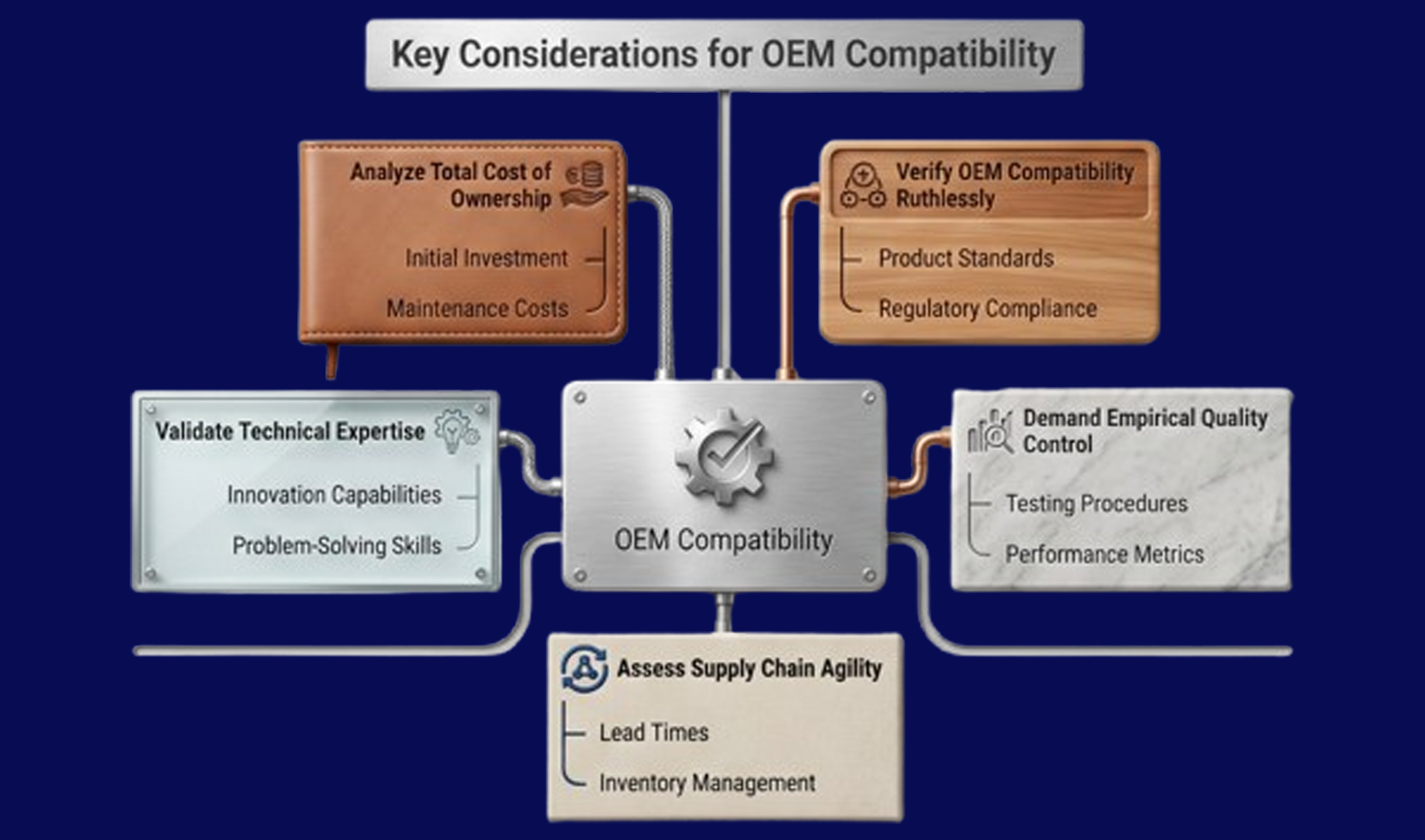
Here are the 5 exclusive factors you need today.
No fluff. Just hard data and conventional truth.
Factor 1: Verify OEM Compatibility Ruthlessly
Most parts look the same.
They are not.
A staggering statistic reveals non-genuine parts fail 40% sooner.
Why risk it? Internal parts rarely interchange.
A piston from one pump wrecks another.
They are not.
A staggering statistic reveals non-genuine parts fail 40% sooner.
Why risk it? Internal parts rarely interchange.
A piston from one pump wrecks another.
You need a supplier who obsesses over specs.
We call this OEM-grade precision.
We call this OEM-grade precision.
First, decode your compressor’s DNA.
Grab the manual. Note the model number exactly.
Check the RPM, voltage, and refrigerant type.
Grab the manual. Note the model number exactly.
Check the RPM, voltage, and refrigerant type.
Next, force your supplier to match thread types.
Mixing NPT and BSP threads guarantees leaks. These mistakes cause pressure drops.
They also waste energy.
Mixing NPT and BSP threads guarantees leaks. These mistakes cause pressure drops.
They also waste energy.
A genuine compressor spare parts supplier verifies this before shipping.
K-nine Spares, for example, ensures micron-level accuracy.
They eliminate the guesswork.
They eliminate the guesswork.
Factor 2: Demand Empirical Quality Control
Certifications are table stakes.
Look for these certifications from government authorities.
But don’t stop at a piece of paper.
Ask for the data. Demand test reports.
Look for these certifications from government authorities.
But don’t stop at a piece of paper.
Ask for the data. Demand test reports.
In the Sub-continent, top suppliers show response times under 1 hour.
They boast on-time delivery rates of 100%.
They boast on-time delivery rates of 100%.
Why does this matter?
Because cheap fittings crack under pressure.
Weak seals cost you air and money.
Because cheap fittings crack under pressure.
Weak seals cost you air and money.
A robust supplier uses CNC machining.
They provide material test reports (MTRs).
They provide material test reports (MTRs).
You want a partner, not a box mover.
Check their reorder rate.
Check their reorder rate.
A rate of 50% or higher proves customer trust.
Companies like K-nine Spares hit this mark.
They retain clients because parts last.
They retain clients because parts last.
Precision machining boosts part life by 20-30%.
That is real value.
That is real value.
Factor 3: Assess Supply Chain Agility
2026 is not 2019.
Global disruptions cut supply by 30% recently.
Red Sea routes face delays, hitting 40%.
You cannot wait 4 weeks for a gasket.
Your compressor spare parts supplier must hold inventory.
Global disruptions cut supply by 30% recently.
Red Sea routes face delays, hitting 40%.
You cannot wait 4 weeks for a gasket.
Your compressor spare parts supplier must hold inventory.
They need a diverse stock.
Look for a wide range of piston sizes and valve types.
A supplier listing over 400 SKUs usually moves fast.
Ask about their buffer stock.
A supplier listing over 400 SKUs usually moves fast.
Ask about their buffer stock.
Do they keep 3-month buffers?
If not, walk away.
If not, walk away.
Agility also means location.
Suppliers in regions like the Sub-continent leverage dense logistics.
They reduce lead times by up to 30%.
Suppliers in regions like the Sub-continent leverage dense logistics.
They reduce lead times by up to 30%.
K-nine Spares serves over 1,000 customers across 90 countries.
They understand global freight chaos.
They help you navigate tariffs.
They understand global freight chaos.
They help you navigate tariffs.
Choose a supplier who diversifies sourcing.
Pivot away from single-region dependence.
Pivot away from single-region dependence.
Factor 4: Validate Technical Expertise (The “Smart” Factor)
You need a consultant.
Not an order taker.
The right supplier asks questions.
Not an order taker.
The right supplier asks questions.
They ask about your operating environment.
Is it humid? Chemical-heavy?
Stainless steel handles moisture best.
Brass works for general setups.
Is it humid? Chemical-heavy?
Stainless steel handles moisture best.
Brass works for general setups.
Your supplier must know this.
They should understand reed valves and bearing loads.
They need to know that piston rings wear every 10,000 hours.
Stop dealing with amateurs.
They need to know that piston rings wear every 10,000 hours.
Stop dealing with amateurs.
Evaluate their response time during an emergency.
Do they reply in 2 hours or 2 days?
Data shows that 70% of buyers choose based on responsiveness.
Fast support prevents lengthy outages.
Fast support prevents lengthy outages.
A smart supplier also provides installation data.
They offer torque specs and voltage tolerances.
They offer torque specs and voltage tolerances.
This saves you from another breakdown next month.
It transforms your maintenance cycle.
It transforms your maintenance cycle.
The K-Nine Advantage
Let’s talk about a real-world example.
K-Nine Spares Pvt. Ltd. fits this mold perfectly.
Based in Kolkata, they focus on high-stakes industries.
K-Nine Spares Pvt. Ltd. fits this mold perfectly.
Based in Kolkata, they focus on high-stakes industries.
They specialize in OEM-grade replacement parts.
We aren’t talking about generic filters.
We are talking about precision pistons and valves.
We aren’t talking about generic filters.
We are talking about precision pistons and valves.
K-Nine uses advanced CNC machining for consistency.
Their quality assurance hits 99.9% dimensional accuracy.
Their quality assurance hits 99.9% dimensional accuracy.
Why does this matter to you?
Because a precise fit cuts energy use by up to 25%.
Because a precise fit cuts energy use by up to 25%.
Users report a 30% reduction in maintenance costs.
They serve major brands like Sabroe and Carrier.
This is the benchmark for reliability.
They serve major brands like Sabroe and Carrier.
This is the benchmark for reliability.
They prove that “genuine” saves more money upfront.
Don’t gamble. Go with the house that wins.
Don’t gamble. Go with the house that wins.
Factor 5: Analyze Total Cost of Ownership (TCO)
Stop looking at the price tag.
Cheap parts are a trap.
Cheap parts are a trap.
A $10 fitting causes a $50,000 shutdown.
That is bad math.
That is bad math.
Non-genuine parts spike failure rates by 50%.
You pay twice. Once for the part. Once for the overtime.
You pay twice. Once for the part. Once for the overtime.
Calculate the TCO.
Genuine parts reduce equipment failure by 40%.
They optimize efficiency.
Think about energy consumption.
A leaking valve makes the compressor work harder.
That burns electricity.
That hurts your ESG (Environmental, Social, and Governance) goals.
They optimize efficiency.
Think about energy consumption.
A leaking valve makes the compressor work harder.
That burns electricity.
That hurts your ESG (Environmental, Social, and Governance) goals.
Invest in longevity.
OEM-grade pistons last 2x longer.
You reduce replacement frequency.
You lower labor costs.
OEM-grade pistons last 2x longer.
You reduce replacement frequency.
You lower labor costs.
Always ask for warranty terms.
Reliable suppliers stand behind their products.
Reliable suppliers stand behind their products.
They offer dispute resolution and Trade Assurance.
That security is worth the premium.
That security is worth the premium.
Conclusion: Build Your Resilient Chain
You have the checklist.
Now go execute.
Now go execute.
Start by auditing your current compressor spare parts supplier.
Rate them on these 5 factors.
If they score low, switch now.
Rate them on these 5 factors.
If they score low, switch now.
Map your risks today.
Diversify your sources.
Diversify your sources.
Keep a buffer stock for critical items.
Prioritize precision over price.
Your compressor is the heart of your operation.
Do not let it flatline.
Prioritize precision over price.
Your compressor is the heart of your operation.
Do not let it flatline.
Visit K9Spares.com to benchmark quality.
Your bottom line will thank you.
Your bottom line will thank you.